
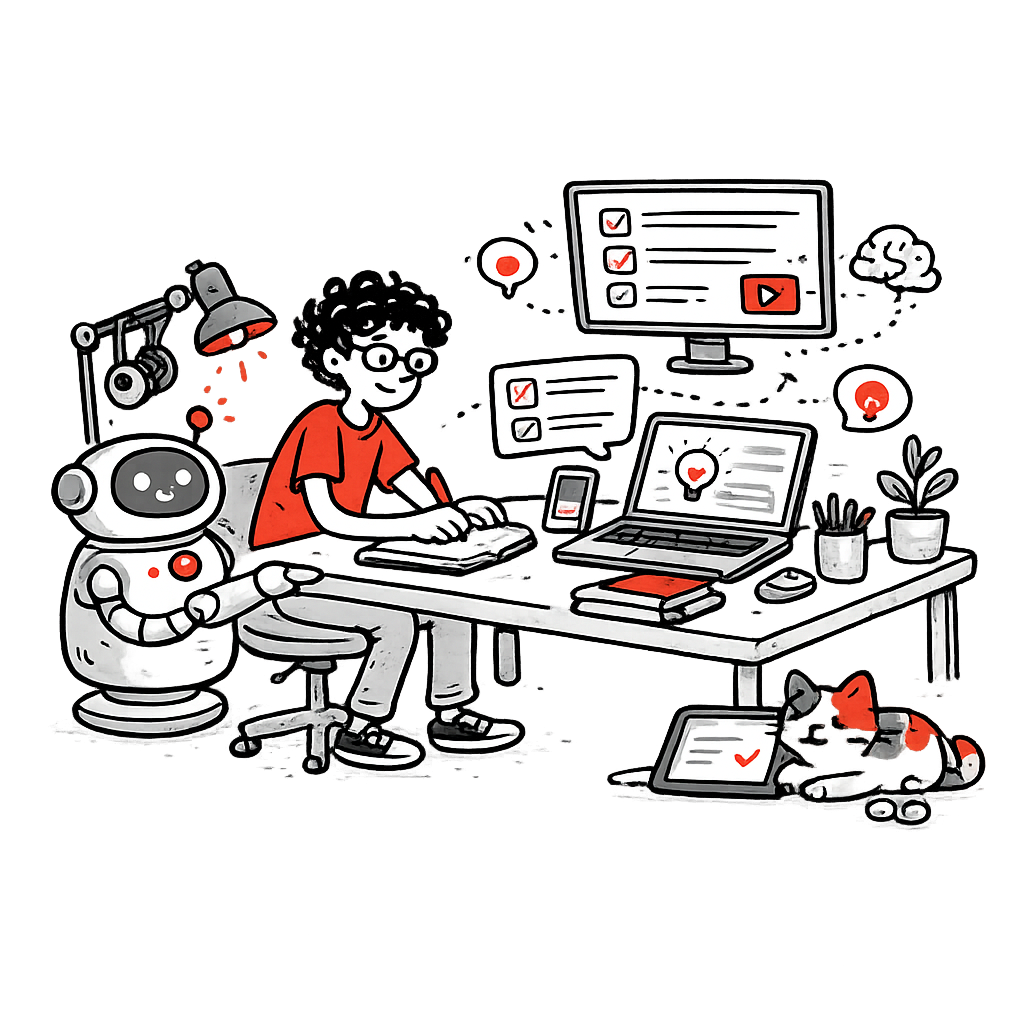
What AI Is Quietly Changing About Learning
AI Is Not Just Changing How We Learn
Most people talk about AI as a tool that can do everything and may take many of our jobs. But it also provides instant summaries, simplified explanations, and constant assistance. All of that is true.
But the most important change is not speed. It is the relationship we are starting to have with mental effort. Many people are no longer learning the same way, they are delegating increasing parts of the cognitive process.
And that changes more than it seems.
“The real problem is not whether machines think but whether men do.”
— B. F. Skinner, psychologist and behaviorist
When Learning Stops Requiring Effort
For a long time, learning involved friction. Reading, researching, making mistakes, reorganizing ideas. Part of the value of learning was in that effort.
AI has reduced much of that friction. And while that improves efficiency, it also removes part of the process that helped consolidate knowledge.
Now, the risk is not using AI. The risk is consuming answers without going through the effort that normally transforms information into understanding.

The Moment I Noticed the Shift
One interesting moment happened at work when a colleague started solving part of the code without truly understanding the concepts behind it.
The problem came when a bug appeared. The AI had started mixing different programming languages. He could produce results, but he could not fix the bug it created and instead made the problem bigger.
AI had given him a usable output, but not deep understanding of why the correct language or implementation mattered.
That’s when I understood something uncomfortable: having access to better answers does not guarantee better learning.
How to Use AI Without Weakening Your Learning
The first step is to use AI after trying to think for yourself. Not before. The tool should complement your reasoning, not replace it.
The second step is to ask for explanation, not just answers. If you only consume solutions, you train dependence, not understanding.
The third step is to verify whether you can reconstruct the idea without help. If you cannot explain it on your own, you probably do not understand it yet.
AI Changes Access, Not the Need to Learn
AI can accelerate access to information, reduce search time, and make guided practice easier.
But it cannot eliminate the need to think, connect ideas, and develop judgment. That part remains human.
The tool changed. Deep mental processing did not.
“Technology is a useful servant but a dangerous master.”
— Christian Lous Lange, historian and Nobel Peace Prize laureate
Future Advantage Will Not Be Using AI
Soon, almost everyone will use AI. That is something we can no longer deny. It will stop being a differentiator.
The real advantage will belong to those who still know how to think deeply while using these tools.
Because if everyone has access to instant answers, value will no longer come from getting answers.
It will come from knowing what to do with them.