For a long time, we were taught a fairly simple idea: study a profession, get a stable job, and stay on that path for most of your life. Honestly, I think that worked reasonably well for previous generations. A professional career was a relatively predictable line.
However, today’s job market looks less and less like that model. Industries change quickly, technology transforms entire professions, and many skills have a much shorter lifespan than they once did. What is valuable today may become obsolete within a few years.
That is why more and more people are starting to feel a discomfort that is difficult to explain. They do not necessarily want to leave their jobs, but they no longer want to depend exclusively on them. They begin to wonder whether building their entire professional life around a single activity is still a good strategy.
“Do not put all your eggs in one basket.” — Andrew Carnegie, industrialist and entrepreneur
Why the Traditional Career Model Is Showing Its Limits
The problem is not having a job. The problem is depending entirely on a single source of experience, learning, and income. When your entire stability depends on one structure, any external change can affect the whole system.
On top of that, many companies no longer offer the same guarantees they once did. Restructuring, automation, outsourcing, and technological change happen constantly. Professional stability no longer depends solely on loyalty or accumulated experience.
There is also a less visible factor. Many people discover that their interests evolve over time. What fascinated you at twenty-five may not generate the same enthusiasm at forty. That creates tension between the career you built and the person you have become. That is something I am experiencing myself.
The Moment I Realized One Direction Was Too Much Risk
I remember a period when most of my experience was concentrated in systems development. I had spent years learning specific tools, methodologies, and technologies. From the outside, it looked like a logical and stable career path.
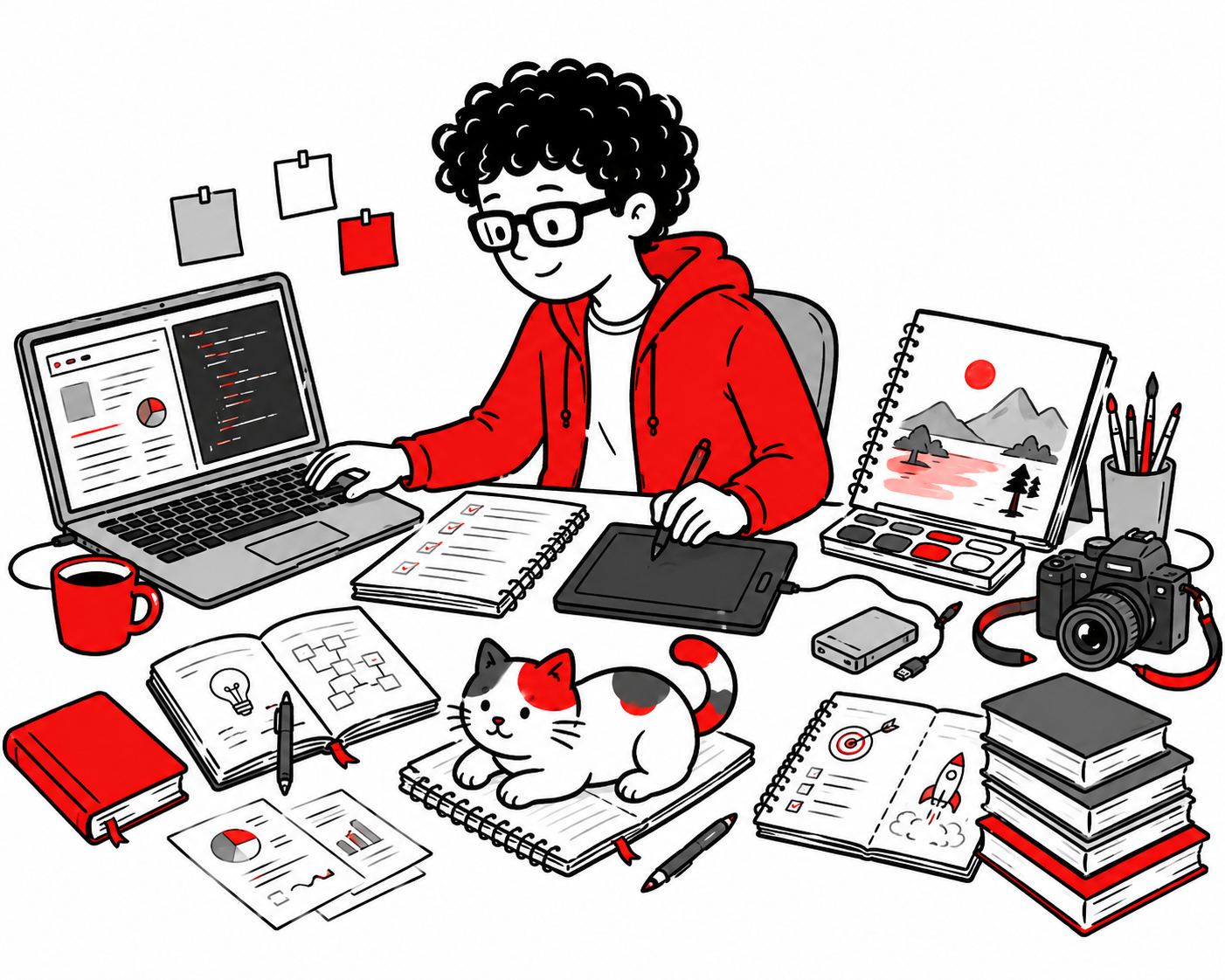
Now, something I will not deny is that I have always enjoyed digital illustration. As I explored it more seriously, I started noticing something interesting. I genuinely loved it. It was something new that I had learned outside my primary job, and it gave me a completely different kind of energy. Then I added writing to the mix, both educational and technical content. Exploring learning-related topics and working on side projects forced me to think in entirely different ways. Not to mention learning how to cook, although I think I will save that story for another time.
That was when I understood something important. The problem was not systems development. The problem was believing that my entire professional identity had to depend on it. The more skills I developed outside my primary job, the more professionally resilient I felt. Better yet, some of those skills eventually started generating additional income.
The first step is to stop thinking only in terms of jobs and start thinking in terms of capabilities. Skills are more flexible than job titles. Problem-solving, writing, teaching, analyzing information, communicating ideas, and building projects can all be applied across multiple contexts.
The second step is to develop a parallel activity that complements your primary expertise. It does not need to become a business immediately. The important thing is to create a second space where you can learn, experiment, and generate value independently.
The third step is to build assets instead of relying exclusively on exchanging time for money. A project, a blog, educational content, a digital tool, or a community can continue generating value even when you are not actively working on it.
The goal is not to abandon everything you do today. The goal is to avoid having your entire stability depend on a single piece.
A Portfolio Career Is More Than Multiple Income Streams
Many people think a portfolio career is simply about having multiple income streams. But the concept goes much deeper than that.
It is about diversifying experience, learning, professional relationships, and opportunities. When you develop different areas of knowledge, you also develop different ways of seeing the world and solving problems.
A portfolio career also creates something extremely valuable in uncertain times: adaptability. If one industry changes, your entire system does not collapse. If one skill loses relevance, you have others to rely on.
It is not a strategy based on doing more things. It is a strategy based on depending less on a single thing.
“Invest in seven ventures, yes, in eight; you do not know what disaster may come upon the land.” — The Bible, Ecclesiastes 11:2
The Future May Belong to Those Who Can Combine Skills
I believe one of the biggest transformations in modern work is that we are no longer competing solely on experience. Increasingly, we are competing on our ability to connect different kinds of knowledge.
The people who are hardest to replace are not always those who master one thing at an expert level. More often, they are the ones who can combine different disciplines, learn quickly, and adapt when the environment changes.
That is why a portfolio career is not just a professional strategy. It is also a way of thinking. A way of building resilience in a world where absolute stability is becoming increasingly rare.
Because in the end, the goal is not to have ten jobs. The goal is to avoid depending entirely on just one.