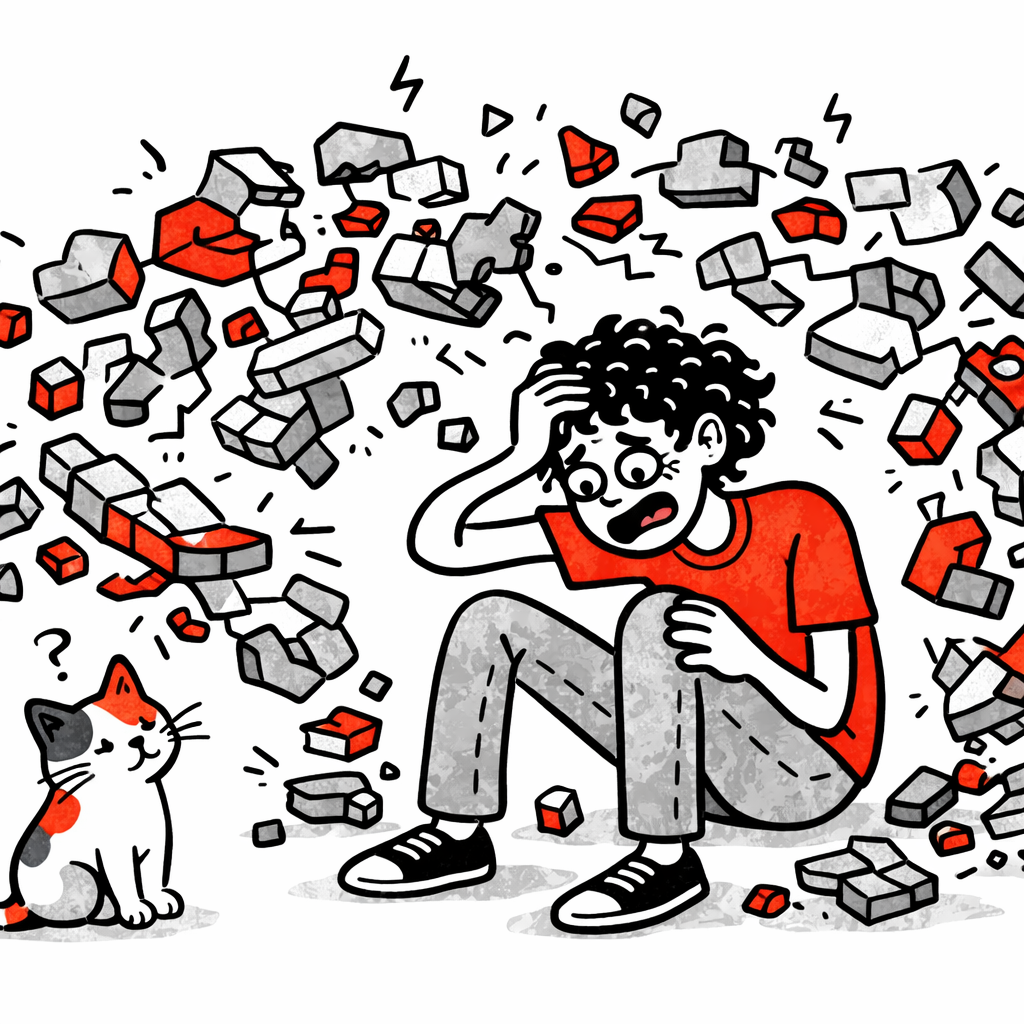
Feeling lost, losing clarity, is a stage in every serious learning process. I had to learn that the hard way when I started going deeper into my own development. What once seemed simple began to feel confusing. You start doubting your ability.
You question whether you are really made for it. That feeling of being lost is not pleasant, but it is more common that we admit. We were taught to associate learning with quick understanding. And the truth is, it does not work that way. At least not for everyone. If you do not understand immediately, you assume you are failing.
But real learning is rarely linear. It looks more like uneven terrain than a neat staircase. Feeling lost does not mean you are going backward. Often, it means you are entering a zone where superficial knowledge is no longer enough.
If you’re not confused, you’re not paying attention. — Tom Peters, management author and business thinker
Confusion Is a Sign of Depth
Take it slowly. When something is truly new or complex, your mind needs to reorganize what it already knows. That process creates internal friction. It is uncomfortable because it requires dismantling old mental structures in order to build stronger ones. And at least in my case, with a mind full of outdated programming languages, trying to learn new ones felt overwhelming.
The problem is that we confuse discomfort with incapacity. We believe that if we do not understand quickly, we are not good enough. But speed is not the best indicator of learning. Transformation is.
Confusion appears when you are leaving easy answers behind. And that is often the beginning of something deeper.
Feeling lost – TheLearningMaker.com
The Moment I wanted to Quit
I clearly remember a period when I was close to quitting a project because I understood nothing. I had already failed Calculus I about four times at university. I read, practiced, tried applying concepts, but everything felt scattered. The frustration was intenese.
Interestingly, about two years later, many of those ideas began connecting. What once felt chaotic slowly gained structure. It was not immediate. It was gradual.
If I had quit at the peak of confusion, I would never have reached that point of integration. that is when I understood that feeling lost was part of the process, not a signal to stop.
I believe it depends on the person. For me, it was mathematics. For some of my classmates, it was programming.
What to Do When You Feel Lost
The first step is to accept the phase without dramatizing it. Feeling lost does not define your ability. It simply describes where you are in the process. That distinction matters.
The second step is to slow down. When everything feels chaotic, trying to accelerate only makes it worse. Breaking the problem into smaller parts restores a sense of control and clarity.
The third step is to keep practicing. Conscious repetition, even when you do not see immediate results, allows your brain to build invisible connections that later become clear.
Real Learning Always Disrupts Before It Builds
Every meaningful learning experience disrupts your previous structure. If you feel no internal disorder, you are probably just reinforcing what you already knew. I have friends who struggle the most with this stage. They resist learning something new, yet grow bored with what they already know, convinced that no one can surpass them. Trust me, it does not work that way.
Disruption is not the goal, but it is an inevitable stage. That in-between space, between what was and what is forming, is precisely what many people avoid. It is the gap between old certainty and deeper understanding.
Accepting that stage changes your relationship with learning. Instead of fearing it, you begin to recognize it as a natural part of growth.
Any fool can know. The point is to understand. — Albert Einstein, theoretical physicist
Looking back, the moments when I felt most lost were the ones that preceded my greatest progress. I could not see it at the time, but now it is obvious. As Steve Jobs once said, the dots connect looking backward.
Learning something real implies transformation. And every transformation passes through uncertainty. It is the price of moving beyond the surface.
The next time you feel lost while learning, do not interpret it as failure. It may be the sign that you are finally learning something that truly matters.